[Mascom Global] Recycled HDPE granules have become one of the most important raw materials in the global plastics industry, especially as manufacturers shift toward sustainable production and circular economy models. HDPE (High-Density Polyethylene) is a versatile polymer widely used in packaging, industrial goods, consumer products, pipes, and many other sectors. As environmental regulations tighten and demand grows for environmentally friendly materials, the use of recycled HDPE granules is growing faster than ever.
This article explains what recycled HDPE granules are, how they are produced, their advantages, and their major applications in modern manufacturing.
What Are Recycled HDPE Granules?

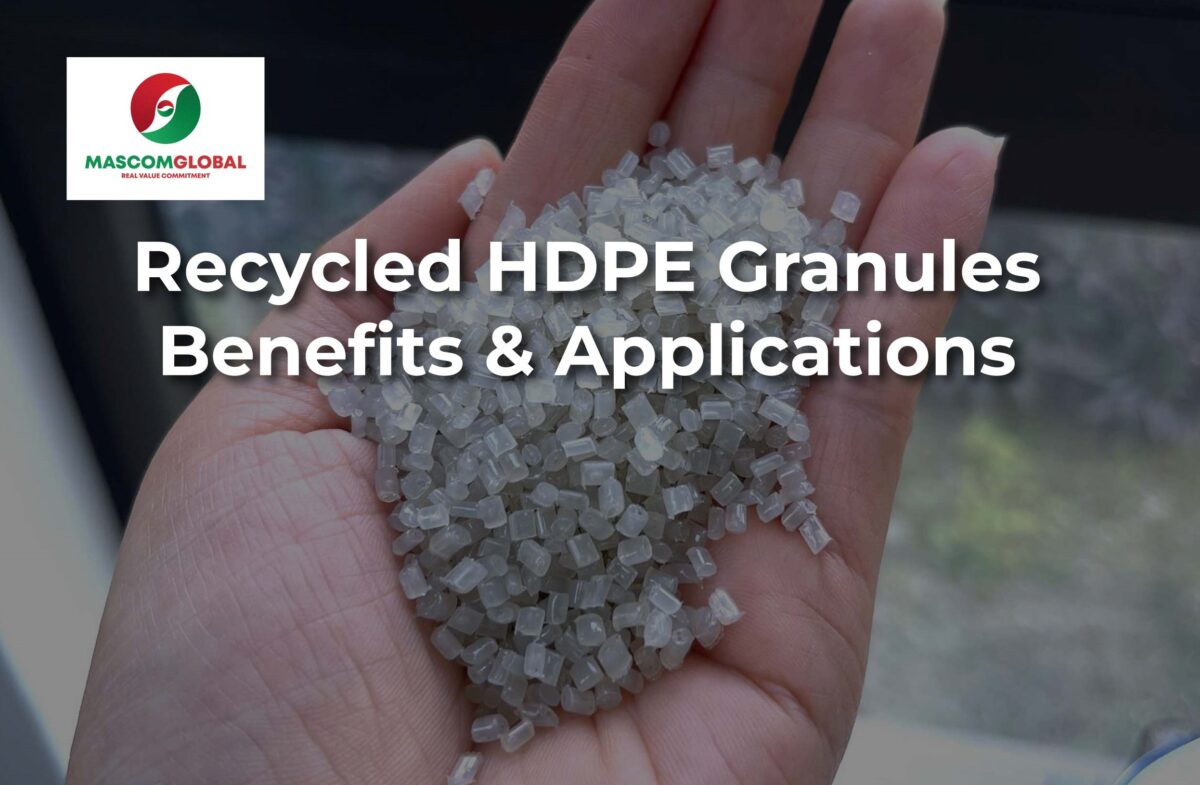
Recycled HDPE granules are plastic pellets produced from used HDPE materials such as bottles, caps, containers, pipes, waste from production lines, and post-consumer plastic waste. Instead of being discarded in landfills or incinerated, HDPE waste is collected, cleaned, processed, and pelletized into granules that can be reused in new plastic products.
HDPE is an ideal material for recycling due to its high resistance to chemicals, strong mechanical properties, and excellent stability under heat. These characteristics allow HDPE to go through multiple recycling cycles while maintaining good performance.
How Recycled HDPE Granules Are Produced?
The production process typically includes:
- Collection & Sorting
Waste HDPE is categorized by type, color, and contamination level. - Washing & Drying
Labels, dirt, residues, and organic waste are removed through hot and cold washing systems. - Shredding
Clean HDPE is shredded into flakes. - Extrusion & Filtration
The flakes are melted, filtered through screens to remove impurities, and processed into uniform granules. - Pelletizing
The molten HDPE is cooled and cut into pellets.
Depending on the purity requirement, recycled HDPE can be classified into:
- Post-industrial recycled (PIR)
- Post-consumer recycled (PCR)
- Mixed recycled HDPE (less strict applications)
Benefits of Using Recycled HDPE Granules
- Cost Reduction
Recycled HDPE is significantly cheaper than virgin HDPE resin. This allows manufacturers to reduce material costs while maintaining acceptable performance.
- Environmental Sustainability
Recycled HDPE granules help:
- Minimize landfill waste
- Reduce CO₂ emissions
- Lower dependency on petroleum-based virgin resin
- Support ESG and sustainability goals
Using recycled raw materials also improves corporate environmental responsibility and enhances brand reputation.
- Stable and Reliable Mechanical Properties
Modern recycling technologies — such as hot wash systems, multi-screen filtering, vacuum degassing, and double-screw extrusion — allow recycled HDPE to retain strong properties such as:
- High tensile strength
- Good rigidity
- Impact resistance
- Chemical resistance
These properties make recycled HDPE suitable for many industrial applications.
- Energy Efficiency
Recycling HDPE consumes far less energy than producing virgin resin. Studies show that recycled plastics require up to 88% less energy in production.
- Versatility in Application
Recycled HDPE can be blended with virgin HDPE or used independently in various products where extreme purity is not required.
Applications of Recycled HDPE Granules

- Plastic Bags and Packaging Film
Recycled HDPE is widely used in:
- T-shirt bags
- Shopping bags
- Garbage bags
- Industrial film
Manufacturers often blend recycled HDPE with virgin PE or filler masterbatch to balance cost and performance.
- HDPE Pipes and Conduits
Lower-grade recycled HDPE granules are suitable for:
- Corrugated pipes
- Cable conduits
- Drainage pipes
These applications do not require extremely high purity.
- Blow-Molded Containers
Recycled HDPE is used to produce non-food packaging such as:
- Detergent bottles
- Lubricant bottles
- Chemical containers
Its rigidity and chemical resistance make it ideal for these uses.
- Injection-Molded Products
Recycled HDPE granules support a wide range of items, including:
- Household goods
- Buckets
- Crates
- Pallets
- Construction fittings
- Sheets and Panels
Recycled HDPE is used in extrusion lines to produce sheets for:
- Furniture
- Construction
- Automotive interiors
- Marine applications
- Agricultural Applications
Recycled HDPE is used in:
- Irrigation components
- Agricultural film
- Nursery pots
Recycled HDPE granules are an essential raw material for sustainable plastic manufacturing. With the dual benefits of cost savings and environmental impact reduction, they are becoming a preferred choice across industries. Improvements in recycling technologies have also enhanced the mechanical performance and consistency of recycled HDPE, allowing it to be used in more demanding applications.
As the world continues shifting toward circular economy practices, recycled HDPE granules will remain a key material driving sustainability in the plastics industry.