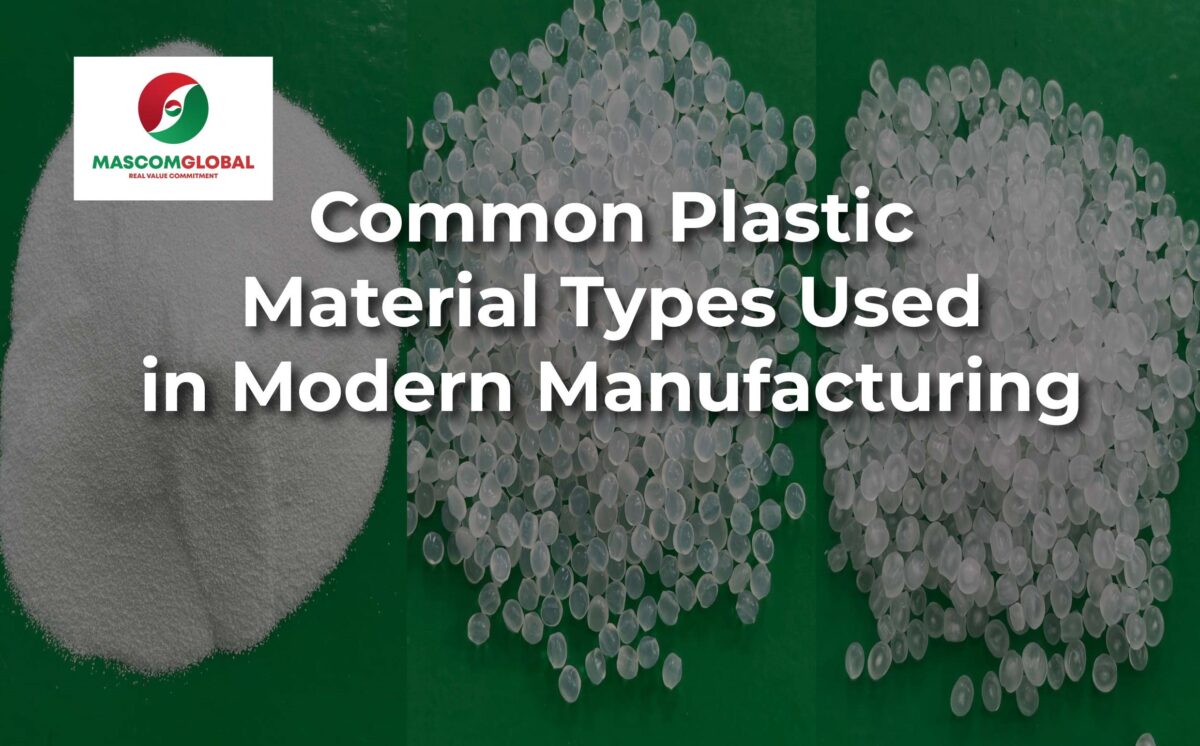
[Mascom Global] Plastics are essential materials in today’s industrial landscape, widely used across packaging, automotive, electronics, construction, medical equipment, household goods, and countless other sectors. Their lightweight nature, durability, versatility, and cost-effectiveness make them indispensable in modern production. However, not all plastics are the same. Each type of polymeric material has unique characteristics that determine its suitability for specific applications, ranging from flexible films to high-performance engineering components.
This article provides a comprehensive overview of the most common plastic material types used in manufacturing today, explaining their key properties, advantages, disadvantages, and typical applications.
1. Polyethylene (PE)
Polyethylene is one of the common plastic material types, widely used plastic globally, valued for its flexibility, excellent chemical resistance, and superior moisture barrier properties. PE is a thermoplastic polymer primarily classified by its density, which dictates its physical properties.

1.1. LDPE (Low-Density Polyethylene)
LDPE is characterized by its soft, flexible nature and high resistance to chemicals and moisture. Its high melt flow index makes it easy to process, particularly in film blowing and injection molding.
- Key Properties: High ductility, low cost, excellent processability.
- Applications: T-shirt bags, flexible packaging films, squeezable bottles, protective films, and liner films.
1.2. HDPE (High-Density Polyethylene)
HDPE offers higher stiffness, improved impact strength, and better moisture resistance compared to LDPE due to less branching in its molecular structure. It is a robust material widely used in rigid packaging and industrial applications.
- Key Properties: High strength-to-density ratio, opacity, and good chemical resistance.
- Applications: Chemical jerry cans, pressure pipes (gas/water), detergent bottles, household containers, and blow-molded products.
1.3. LLDPE (Linear Low-Density Polyethylene)
LLDPE is known for its superior toughness and puncture resistance, making it ideal for applications requiring flexibility and high durability, often achieved through a co-extrusion process.
- Applications: Stretch film (pallet wrapping), agricultural films, heavy-duty garbage bags, and flexible tubing.
2. Polypropylene (PP)

Polypropylene is a lightweight polymer known for its high stiffness, high melting point, and excellent chemical resistance. It is one of the most versatile thermoplastics, used extensively in both rigid and flexible applications. A key feature is its fatigue resistance, making it ideal for living hinge applications.
- Key Properties: Low density, high heat distortion temperature, good electrical insulation.
- Applications: PP woven bags and jumbo bags, microwave-safe food containers, bottle caps (closures), automotive interior trim parts, and non-woven fabrics for medical masks and filters.
3. Polyvinyl Chloride (PVC)

PVC is one of the most adaptable plastics, available in both rigid (uPVC) and flexible (plasticized PVC) forms, depending on the use of plasticizers. This versatility is its main advantage.
- Key Characteristics:
- Good abrasion resistance and inherent flame resistance (due to chlorine content).
- Excellent chemical stability.
- Hardness and flexibility are easily adjustable.
- Applications: PVC pipes and fittings, window and door profiles, synthetic leather, resilient flooring, electrical wire insulation, and medical tubing (flexible grade).
4. Polystyrene (PS)
Polystyrene is typically offered in two main grades: GPPS and HIPS.
4.1. GPPS (General Purpose Polystyrene)
GPPS is clear, rigid, and glossy, though it is characteristically brittle. It is a cost-effective and easy-to-mold material.
- Applications: Disposable cups and cutlery, transparent storage boxes, and clear food packaging trays.
4.2. HIPS (High Impact Polystyrene)
HIPS is significantly tougher and impact-resistant due to the incorporation of a rubber phase (often polybutadiene).
- Applications: Electronic housings, toys, refrigerator liners, and durable point-of-purchase (POP) displays.
5. PET (Polyethylene Terephthalate)
PET is famous for its excellent clarity, high strength, and superior food safety properties. It exhibits a good barrier to gas and moisture, making it essential for beverage storage.
- Key Properties: High rigidity, low permeability, and excellent recyclability (often designated with the Resin Identification Code '1').
- Applications: Carbonated beverage bottles, food containers (clamshells), polyester fibers for textiles (known as Dacron or Terylene), and thermoformed packaging.
6. ABS (Acrylonitrile Butadiene Styrene)
ABS is a durable engineering plastic known for its exceptional balance of strength, stiffness, and impact resistance — even at low temperatures. It is an amorphous polymer often used when aesthetics are important due to its easy finishing.
- Applications: Automotive interior and exterior components, helmet shells, home appliance casings, consumer electronics (monitor casings), and LEGO bricks.
7. PC (Polycarbonate)
Polycarbonate is a high-performance material renowned for its extreme impact resistance (virtually unbreakable) and high transparency (optical clarity).
- Key Properties: Excellent heat resistance, dimensional stability, and flame retardancy. It is often referred to as "transparent steel".
- Applications: Safety glazing (bullet-resistant windows), roofing sheets, medical devices (dialysis components), reusable water bottles, and optical lenses.
8. PA (Nylon - Polyamide)
Nylon is a family of strong engineering plastics known for its excellent abrasion resistance, high tensile strength, and good dimensional stability. It is also naturally self-lubricating.
- Applications: Mechanical components (gears and bearings), cable ties, automotive under-the-hood parts (engine covers, manifolds), and textile fibers.
9. EVA (Ethylene Vinyl Acetate)
EVA is a flexible, rubber-like plastic widely used where shock absorption and resilience are required. Its properties depend on the vinyl acetate (VA) content.
- Applications: EVA foam for footwear (midsoles), hot-melt adhesives, agricultural films, soft packaging, and sports protective gear.
Conclusion: The Imperative of Material Selection
Understanding the different types of plastic materials is critical for manufacturers to select the correct polymer for each application. Every resin offers a unique set of strengths and limitations. Selecting the correct material is a complex decision based on:
- Performance Requirements: Heat resistance, chemical exposure, impact rating, and mechanical stress.
- Processing Method: Compatibility with injection molding, blow molding, extrusion, or thermoforming.
- Cost and Scalability: Balancing raw material cost with processing efficiency and volume.
- Sustainability Goals: Considering the material's potential for recycling and overall lifecycle impact.
Knowledge of these plastic types helps optimize production, reduce material waste, and ensure consistent product quality, driving innovation and efficiency across the modern competitive manufacturing environment