
[MASCOM GLOBAL] When you look at Black Masterbatches, they may seem like simple black granules.
But behind that small pellet is a complete production process involving formulation, carbon black dispersion, extrusion, cooling and pelletizing technology.
And one of the most interesting differences is how the material is transformed from a molten compound into a finished pellet.
🔥 HOT CUTTING FOR BLACK MASTERBATCHES - CUT FIRST, COOL LATER

In the hot die-face pelletizing process, Black Masterbatches are melted and homogenized during extrusion.
The molten material is then pushed through a die, where it is cut directly into pellets while it is still hot.
The freshly cut pellets are subsequently cooled and stabilized.
This process allows pellet formation to take place directly at the die face.
The key to a stable hot-cutting process is precise control of parameters such as:
- Melt temperature
- Die temperature
- Extrusion pressure
- Cutting speed
- Cooling efficiency
When these parameters are properly balanced, hot cutting can produce compact, consistent and well-shaped pellets.
❄️ COLD CUTTING FOR BLACK MASTERBATCHES - COOL FIRST, CUT LATER
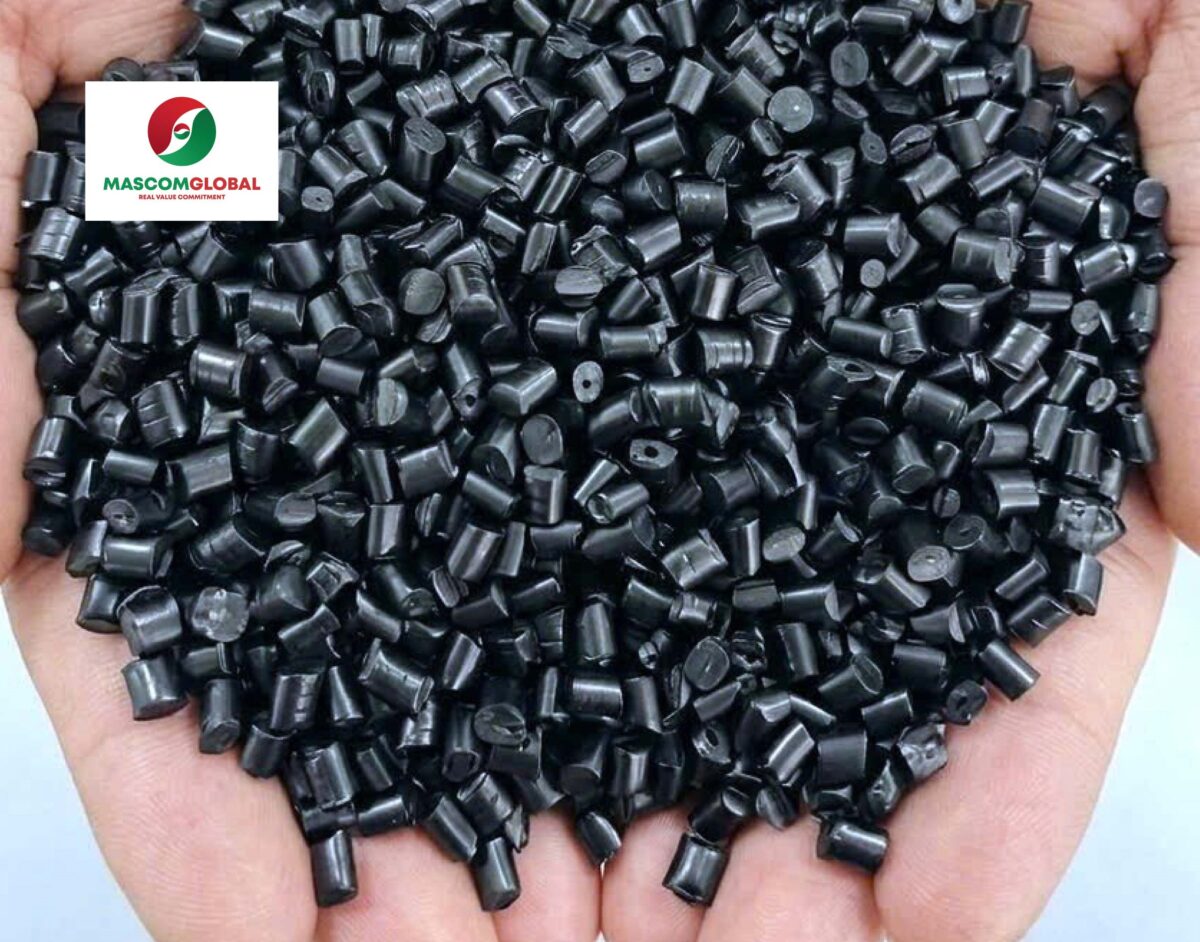
Cold cutting follows a different route.
Black Masterbatches are extruded through the die to form continuous strands.
These strands are then passed through a cooling water bath or under a flow of cooling water, allowing them to solidify.
Once the strands have become sufficiently solid, they are fed into a pelletizer and cut into individual pellets.
Here, the stability of the strand is extremely important.
The strand needs to have the right combination of strength, flexibility and cooling stability to pass smoothly through the pelletizing system.
If the strand is unstable, too brittle or insufficiently cooled, irregular pellets or pelletizing interruptions may occur.
🔍 SO, IS ONE BETTER THAN THE OTHER?
Not necessarily.
The choice between hot cutting and cold cutting should be based on the formulation, polymer carrier, carbon black loading, processing conditions and final application.
For Black Masterbatches, the cutting method alone does not guarantee product quality.
A good pelletizing process starts much earlier - with the formulation itself.
🖤 CARBON BLACK DISPERSION COMES FIRST
Carbon black has a very high surface area and strong tendency to form agglomerates.
Therefore, achieving good dispersion is one of the most important challenges in the production of Black Masterbatches.
Poor dispersion can lead to:
- Uneven color
- Lower coloring strength
- Black spots or streaks
- Processing instability
- Inconsistent final products
This is why the formulation, mixing process and extrusion conditions must work together before the pellet even reaches the cutting stage.
⚙️ THE RIGHT BLACK MASTERBATCH IS MORE THAN A GOOD-LOOKING PELLET
A Black Masterbatch pellet may look perfectly uniform from the outside.
But the real test begins when it enters the customer's production line.
Can it disperse quickly?
Does it provide consistent blackness?
Is feeding stable?
Does it work well at the recommended let-down ratio?
Does it maintain the required mechanical and processing properties?
These are the questions that truly define masterbatch performance.
🎯 FROM PELLETIZING TO FINAL APPLICATION
Different applications can place very different demands on Black Masterbatch.
Blown Film may require excellent dispersion and stable processing.
Injection Molding may place greater emphasis on color strength, flow and surface appearance.
Raffia and woven applications may require a balance between color performance and mechanical properties.
Therefore, there is no universal “best” Black Masterbatch simply based on whether it is hot-cut or cold-cut.
The better approach is to match:
Carbon Black + Carrier Resin + Dispersion + Processing Technology + Pelletizing Method + Final Application
That is where technical know-how makes the difference.
At Mascom Global, we believe that a masterbatch should be engineered around the customer's production process - not simply produced as a standard black pellet.
🖤 Because the quality of a Black Masterbatch is not decided by the pellet alone.
It is decided by what that pellet can deliver inside the final product.