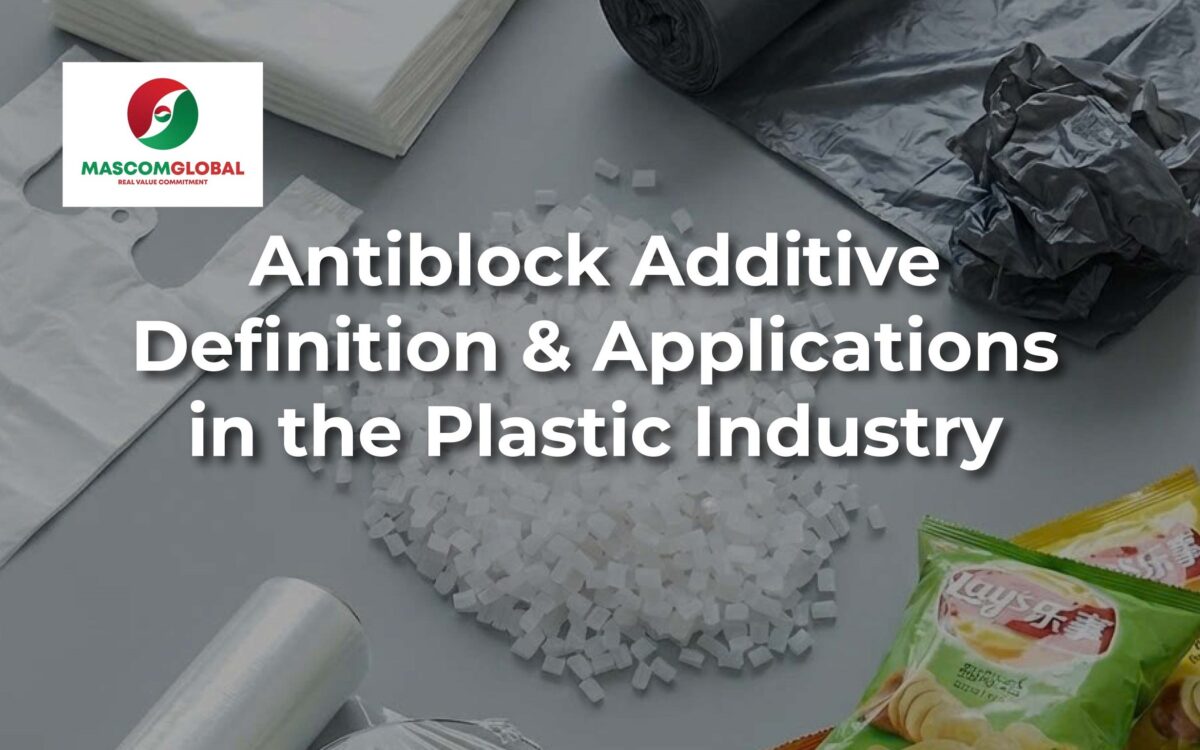
In modern plastic packaging production — especially PE, PP, BOPP films and nylon bags — manufacturers face increasing demands for high production speed and excellent surface quality. One of the most common and disruptive issues is film blocking, where two film layers adhere tightly to each other, causing difficulties during winding, unwinding, and packaging.
To solve this problem, Antiblock Additive (Antiblock Masterbatch) is widely recognized as an essential technical solution in film manufacturing.
1. What Is Antiblock Additive?

Antiblock is an additive used during film production to reduce the adhesion between film layers, ensuring the film separates easily during winding and unwinding.
Antiblock masterbatch typically contains:
- Micro-inorganic particles (such as silica, talc, ultra-fine calcium carbonate, zeolite…)
- Dispersing agents to ensure uniform particle distribution
- Polymer carriers like PE or PP
When added into the film, these micro-particles create tiny surface protrusions, which reduce contact area and lower the adhesion force between two film layers. This results in films that are easier to separate, easier to process, and less prone to defects during production.
2. Why Do Plastic Films Stick? – Technical Root Causes
Film blocking occurs due to several factors:
- High film temperature during winding
Freshly extruded film is still hot. Combined with winding pressure, the warm layers stick together.
- Excessive surface gloss
Higher gloss means a larger contact area → higher blocking tendency.
- Film formulation with high slip additive content
While slip agents reduce friction, excessive slip can increase blocking in certain structures.
- High winding pressure
Strong compression makes layers harder to separate.
- Films that are too thin
Thinner films have higher contact adhesion → antiblock becomes mandatory.
This is why antiblock masterbatch is widely used across film production lines.
3. Applications of Antiblock Additive in the Plastic Industry
Antiblock additives are used in most flexible packaging products.
3.1. PE Films (LDPE, LLDPE, HDPE)
- Shopping bags
- Garbage bags
- Food packaging
- Agricultural film
- Industrial packaging film
Antiblock helps:
✔ Easy film separation
✔ Fewer creasing problems
✔ Reduced roll defects at high machine speeds
3.2. PP, CPP, BOPP Films
Crucial in:
- Food packaging
- Snack packaging
- FMCG packaging
PP-based films typically have high gloss → very prone to blocking → antiblock is a required additive.
3.3. Shrink Film & Cling Film
Antiblock prevents roll sticking and improves downstream packaging efficiency.
3.4. Automatic T-shirt Bags (Supermarket Bags)
Antiblock improves:
✔ Faster bag opening
✔ Fewer mouth-sealing defects
✔ Easy opening even with moist hands

4. How Antiblock Additive Works – Scientific Explanation
Adding antiblock to polymer causes the micro-particles to migrate slightly and appear on the film surface, creating micro-roughness points.
These points:
- Reduce the actual surface-to-surface contact area
- Reduce Van der Waals forces that cause blocking
- Create micro air gaps between layers
Resulting in:
✔ Smoother film handling
✔ Lower friction
✔ No sticking during winding
✔ Stable extrusion and printing performance
5. Key Factors Affecting Antiblock Performance
- Particle size ofantiblock
Larger particles → stronger antiblock effect but may reduce film clarity.
- Dosage (loading rate)
Typically 1–3% depending on film structure.
- Compatibility with base resin
- Dispersion quality inside the film
This is why many factories choose high-quality antiblock masterbatch to ensure excellent dispersion and no haze or white spots.
6. Mascom Global Antiblock Solutions – Optimized for Film & Packaging Manufacturers
Mascom Global is one of the leading suppliers of:
- Antiblock Masterbatch
- Additive Masterbatch (UV, Slip, Anti-static…)
- CaCO₃ Filler Masterbatch
- Color Masterbatch
Suitable for:
✔ PE, PP, BOPP films
✔ Nylon bags, garbage bags
✔ Agricultural films
✔ Food packaging
Advantages of Mascom Global Antiblock:
⭐ Excellent dispersion – no white dots
⭐ Strong antiblock performance while maintaining high film clarity
⭐ Suitable for high-speed extrusion, printing, and cutting
⭐ Does not reduce mechanical strength
⭐ Stable, consistent quality meeting European standards
Mascom also supports sample testing and formula optimization for each specific film application to ensure maximum performance.
7. Conclusion
Antiblock additive plays a critical role in eliminating film blocking in plastic packaging manufacturing. By improving film separation, antiblock helps:
✔ Boost production efficiency
✔ Reduce roll defects
✔ Improve machine handling
✔ Enhance final packaging quality
To achieve the best results, manufacturers should select high-quality antiblock masterbatch with excellent dispersion and strong resin compatibility.
Mascom Global proudly provides high-performance antiblock masterbatch, additive masterbatch, filler masterbatch, and color masterbatch solutions — engineered to meet European standards and help factories reduce costs while increasing productivity.